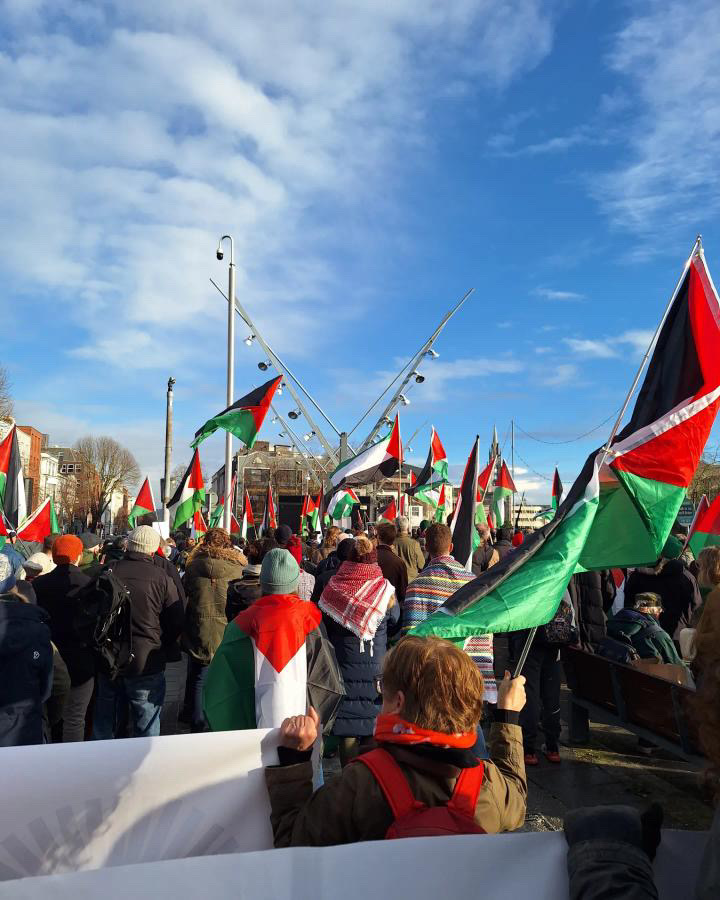
Last Wednesday 29th November marked the annual UN International Day of Solidarity with the Palestinian People, to highlight the ongoing occupation of Palestine since its partition to create the state of Israel in 1947, and below is the email I sent to 2000 colleagues and 80 EDI practitioners in Universities across Ireland, in case it may be of use to you in better understanding the ongoing conflict.
“The International Day of Solidarity traditionally provides an opportunity for the international community to focus its attention on the fact that the question of Palestine remains unresolved and that the Palestinian people have yet to attain their inalienable rights as defined by the General Assembly, namely, the right to self-determination without external interference, the right to national independence and sovereignty, and the right to return to their homes and property, from which they have been displaced.”
Source: UN
This day is an important opportunity to clarify that while there are religious aspects to the conflict that can make it feel too complex to discuss, this situation is one of occupation and oppression, which we all have a duty to name and address under International Humanitarian Law, our Public Sector Human Rights Duty, and the UN Sustainable Development Goals, particularly number 16:
“Promote peaceful and inclusive societies for sustainable development, provide access to justice for all and build effective, accountable and inclusive institutions at all levels.
Source: UN SDGs
How do we speak about this respectfully?
In order to have respectful conversations about what can feel like a complicated issue, the following distinctions are important:
- Antisemitism: Prejudice, hostility, or discrimination towards Jewish people on religious, cultural, or ethnic grounds. (Source: Oxford English Dictionary)
- Zionism: a movement among Jewish people for the re-establishment of a Jewish nation in Palestine. (Source: OED)
- Anti-Zionism: Opposition to Zionism. (Source: OED)
- Islamophobia: Intense dislike or fear of Islam, esp. as a political force; hostility or prejudice towards Muslims. (Source: OED)
- Dehumanise: To deprive of human character or attributes. (OED)
Criticism of the Israeli government is not in and of itself antisemitic, as it is the same as criticising any other government or method of governance, but it is often used to reduce opposition to actions in breach of Palestinian human rights, which in turn increases the risk of harm for us all:
“At a time when white supremacists and white nationalists take advantage of this moment to sow confusion and promote antisemitism, Islamophobia, and racism, misstating what antisemitism is harms all of our work for justice and endangers our communities.”
Source: Jewish Voice for Peace
It is essential that we avoid generalisations and assumptions – not all Jewish or Israeli people support the actions of the Israeli government, just as not all Muslim or Palestinian people support the actions of Hamas. The use of dehumanising language is directly linked to legitimising inhumane treatment and therefore it is important that we remember our common humanity in how we reference people, their actions and behaviours in order for all human life to be equally respected and protected.
How do I learn more about this situation?
To better understand the history, the displacement of Palestinian people and occupation of Palestinian territory is summarised in this simple guide, and represented in the image below, beginning with the British involvement in 1917:
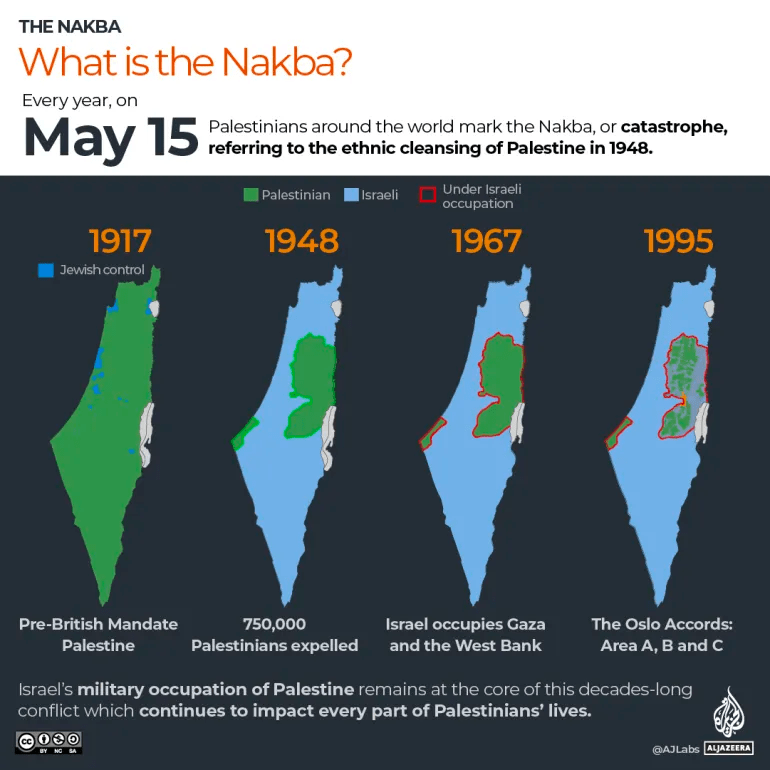
Source: Al Jazeera, October 2023
It is important that we all educate ourselves as a peaceful solution for Israeli and Palestinian citizens will only be brought about through diplomacy and international recognition of the documented persecution of Palestinian citizens by the current Israeli government. Source: Human Rights Watch
How do I demonstrate solidarity with Palestine and other occupied nations?
If you would like to demonstrate solidarity, you can:
- Educate yourself on the history of Palestine by reading this short guide.
- Donate to Medical Aid for Palestinians, who work on the ground to provide aid directly to the Palestinian people.
- Follow Ireland Palestinian Solidarity Campaign and UK Palestine Solidarity on Instagram
- Discuss the situation with friends and family, despite the evidence presented by organisations such as the UN and Amnesty International, many people are unaware that Israel is an occupying force in violation of international law.
- Learn more about Sudan, the Congo, Tigray, and other human rights abuses through Amnesty International.
 Siobhán Kangataran